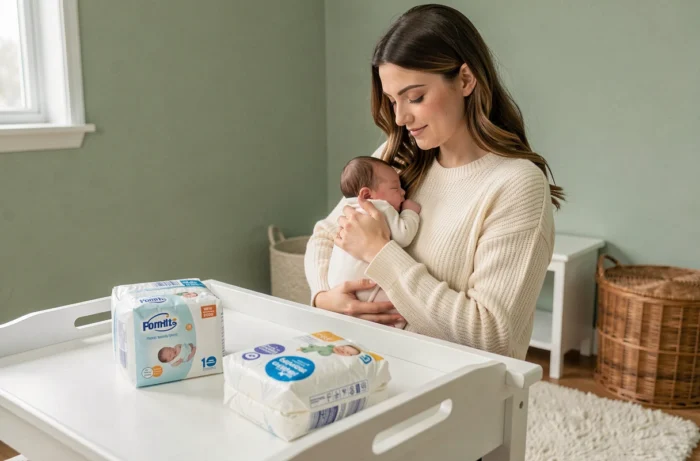
Your baby has just been born, and the diaper aisle looks like a wall of colorful packages. Among the Pampers ranges designed for newborns, Harmonie and Premium Protection consistently appear in shopping carts. Both promise softness and absorption, but their compositions differ in ways that matter for an infant’s skin.
Composition of Pampers diapers: what each range really contains
The most noticeable difference between Harmonie and Premium Protection lies in the list of ingredients that come into contact with the skin. Pampers Harmonie features a formulation fragrance-free, lotion-free, and hypoallergenic. The range incorporates about 50% plant-based materials (cotton, plant fibers).
One detail deserves attention: Harmonie contains a mineral odor absorber. Specifically, the odor is not masked by a chemical fragrance but captured by a mineral-based additive. For parents who read labels, this is an important point to know before concluding that the diaper is completely neutral.
Premium Protection, on the other hand, may include lotion-type ingredients in some variants: petrolatum, stearyl alcohol, paraffinum liquidum, aloe vera extract. These substances aim to protect the skin, but petroleum derivatives like petrolatum can raise questions for very reactive skin. If your newborn already shows redness or has an atopic tendency, this difference in formulation is significant.
To delve deeper into the comparison between these two references, a detailed guide on Pampers Harmonie vs Premium Protection diapers allows you to visualize the technical differences range by range.
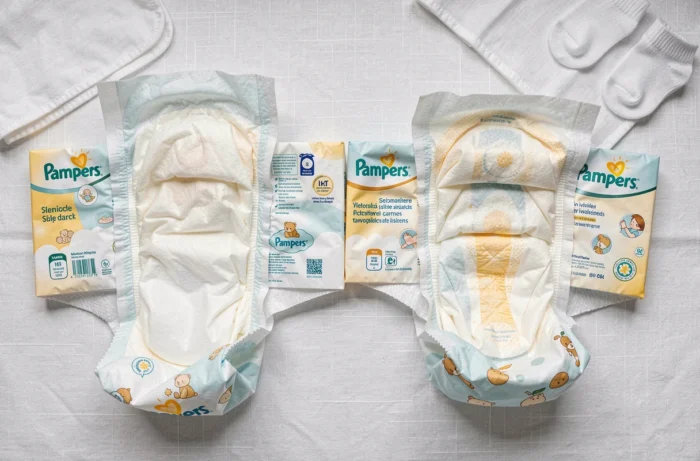
Absorption and leaks at night: Harmonie or Premium Protection for a newborn
Have you ever changed a soaked onesie at 3 AM? Absorption capacity is the criterion that practically distinguishes these two ranges in daily use.
Pampers Harmonie claims absorption of up to 12 hours in certain sizes. The absorbent core relies on a blend of plant fibers and classic superabsorbent polymers. In practice, for newborn sizes (size 1 and 2), this duration greatly depends on the volume of liquid and the baby’s morphology.
Premium Protection uses an absorbent pad that Pampers positions as its most effective technology against leaks. The diaper features a moisture indicator that changes color when the diaper is wet. Harmonie does not offer this indicator on all sizes.
For a newborn who sleeps in short stretches and requires frequent changes, the difference in absorption between the two ranges remains modest. The moisture indicator of Premium Protection is especially useful in the first weeks when parents are still learning to recognize the signs of a full diaper.
Fit and thigh elastics
One point that online comparisons often overlook: the cut. Premium Protection offers wider elastics and a fastening system that wraps more around the baby’s belly. On a premature baby or a very small size, this fit limits lateral leaks.
Harmonie adopts a slightly softer cut, with an outer layer that is softer to the touch. The compromise lies between textile comfort and a snug fit. A low-weight baby will often be better secured in a Premium Protection, while an average-weight newborn will not feel a noticeable difference.
Price of Pampers diapers for babies: the real cost per change
The unit price varies depending on the purchase format (single pack, monthly pack, promotional lot). Comparing the two ranges based on a single pack does not reflect the actual budget in the first months.
- Pampers Harmonie costs slightly more per unit than Premium Protection, due to its “natural” positioning and the use of plant-based materials.
- Premium Protection is more readily available on promotions in supermarkets and in large monthly packs, which lowers the price per diaper.
- In the first three months, a newborn uses an average of five to eight diapers per day. Even a small difference in unit price adds up quickly.
The choice between the two ranges represents a significant budget difference over a quarter. Parents who prioritize plant-based composition accept this extra cost. Those looking for the best absorption/price ratio for daily use tend to lean more towards Premium Protection.

Skin tolerance and certifications: choosing according to your baby’s skin
Why does this choice matter so much for a newborn? Because a newborn’s skin barrier is not mature. It absorbs more substances that come into contact with the skin than an adult epidermis.
Pampers Harmonie is certified by dermatological labels and features a composition designed to limit allergens. The absence of lotion and fragrance reduces the number of molecules in contact with the skin, which decreases the risk of reaction.
Premium Protection is also dermatologically tested, but its lotion contains ingredients like liquid paraffin and petrolatum. These substances are common in infant cosmetics and do not pose a problem for most babies. However, for a newborn with an identified allergic tendency from birth, the minimalist formulation of Harmonie offers an additional margin of safety.
- Normal skin, no history: both ranges are suitable without restriction.
- Frequent redness, early eczema: Harmonie limits exposure to petroleum derivatives.
- Premature baby with fragile skin: consult a pediatrician, some maternity wards recommend lotion-free diapers.
The final choice depends on your baby’s skin profile and your budget. Harmonie focuses on the purest composition, while Premium Protection emphasizes absorption and fit. A newborn with sensitive skin will benefit more from Harmonie. A baby without specific skin concerns will be well protected by either range, and the price criterion may then be the deciding factor.