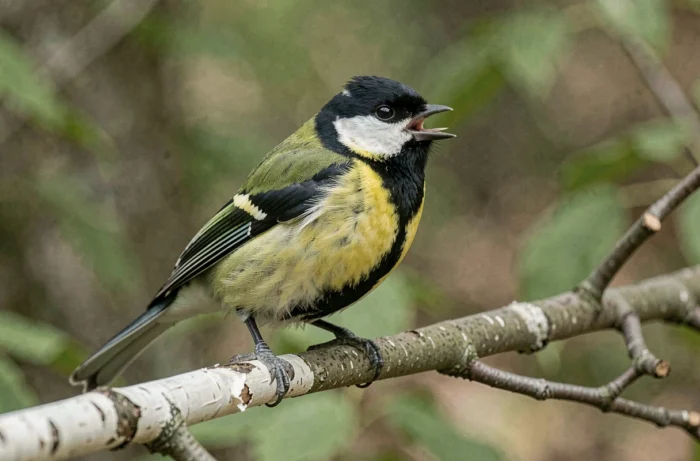
You are in the garden, coffee cup in hand, and a bird is endlessly repeating a note that sounds like “eight, eight, eight.” The sound is clear, almost mechanical. Yet, it is impossible to spot the animal in the foliage. This brief and insistent song most often belongs to a small, discreet passerine, well-known to ornithologists but rarely identified by walkers.
The alarm call of the nuthatch, often confused with a song
Most articles on bird songs overlook a fundamental distinction. What you perceive as “eight eight” is generally not a courtship song, but a contact or alarm call. The nuthatch (Sitta europaea) produces exactly this dry, nasal note, repeated in a rapid series.
A song serves to mark territory or attract a mate. A contact call, on the other hand, maintains the link between individuals or signals danger. The nuthatch uses its “eight” all year round, not just in spring. This is why you can hear it in the middle of winter, while the majority of birds are silent.
If you are looking to find out which bird makes eight eight, the nuthatch is at the top of the list in wooded areas of Europe. Its call is distinguished by a nasal, almost metallic tone, emitted from the trunk of a tree where it moves head-down.
Nuthatch or great tit: distinguishing two similar calls
The most frequent confusion occurs with the great tit. Its territorial song, a regular “ti-tu, ti-tu,” can resemble a repeated “eight” when heard from a distance or through a closed window.

Here are the criteria to differentiate them by ear:
- Rhythm: the nuthatch emits irregular notes, sometimes in bursts, sometimes isolated. The great tit produces series of two notes, regular as a metronome.
- Timbre: the nuthatch’s “eight” is nasal and slightly hoarse. The great tit’s is clearer, more fluted.
- Period: the great tit sings mainly from January to June. The nuthatch calls all year round, including in autumn.
- Position in the tree: the nuthatch moves on trunks and large branches. The great tit prefers thin twigs and feeders.
A third candidate exists in the south of France: the lesser spotted woodpecker, whose sharp, repeated call can evoke an “eight.” Its note is sharper and faster than that of the nuthatch.
Identifying a bird song with an app: what Merlin and BirdNET do (and do not do)
Sound recognition apps have transformed amateur ornithology. Merlin Bird ID, developed by the Cornell Lab of Ornithology, and BirdNET, from Chemnitz University of Technology, both analyze sounds in real-time using artificial intelligence.
Merlin works offline once the regional pack is downloaded. You open the app, start recording, and the detected species appear live on a spectrogram. BirdNET offers a similar function, with the option to record a clip and submit it for analysis.
These tools have a concrete limitation. A study reported by the LPO in 2025 shows that, during field counts, human observers detect more species than smartphones. Weak, distant calls or those partially masked by the wind often escape the algorithm.
For a discreet “eight eight” emitted from a dense hedge, the app may hesitate between several species or detect nothing at all. The spectrogram remains useful as a learning tool, but the trained ear retains a clear advantage in ambiguous situations.

Training your ear to the songs of garden birds: a progressive method
Recognizing a song is not learned in a day. The most effective method is to associate a sound with a specific visual context rather than memorizing written descriptions.
Start with a single bird. Settle in your garden or a park, visually spot a nuthatch or a great tit, and listen for several minutes. Your brain will gradually associate the timbre with the plumage and behavior.
Then add one species per week. Three to four well-known birds are better than a list of twenty confusing songs. The wood pigeon, the European robin, and the blackbird form an accessible starting trio because their songs are very different from each other.
- Listen to the same bird at different times and distances to perceive variations in volume and rhythm
- Use classic mnemonics: the wood pigeon “coos in five syllables,” the robin strings together irregular melodic phrases
- Combine direct listening with recordings on specialized sites like oiseaux.net, which offers fact sheets with photos and sounds for each species
Dawn remains the best time to practice. Birds sing louder, longer, and the sounds of the city are still discreet.
The “eight eight” that intrigues you is probably just a few meters away, on an oak or walnut trunk. The nuthatch does not migrate and remains faithful to its territory. Once you have spotted its nasal call and compact silhouette clinging to the bark, you will no longer confuse it with any other bird in the garden.