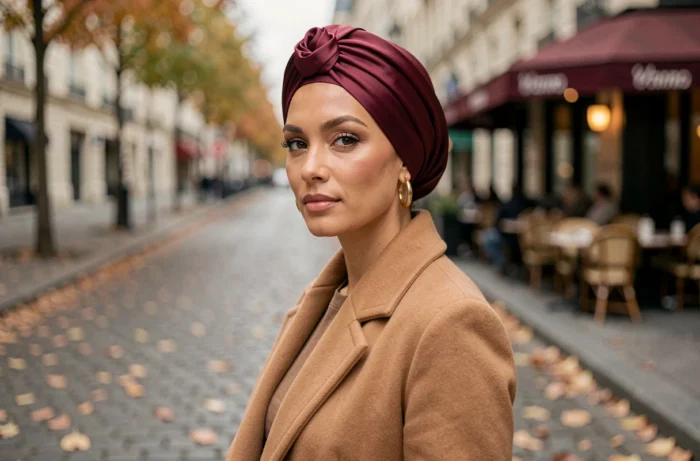
The turban refers to a piece of fabric wrapped around the head, worn for centuries across several continents for religious, cultural, or aesthetic reasons. In women’s fashion, it has established itself as a full-fledged accessory, capable of transforming a simple outfit into a bold silhouette. The trend of the chic turban for women today sits at the intersection of modest fashion and contemporary urban wardrobe.
Chic turban and modest fashion: an accessory turned centerpiece
The modest fashion segment is experiencing continuous growth, with projections of increases until the end of the decade. Head-covering pieces, with turbans at the forefront, are no longer confined to a religious context. They now integrate into streetwear silhouettes and accessible luxury.
The first Modest Fashion Week held in Paris in April 2026 highlighted hybrid turbans, inspired by streetwear and designed for a transgenerational audience. Turban and beret overlays were presented, deliberately blurring the line between utilitarian headgear and style accessory.
This positioning explains why the chic turban is no longer reserved for a single profile of woman. Whether the motivation is religious, medical (alopecia, chemotherapy), or purely aesthetic, the piece functions as a structuring element of the look. Browsing the shopping on Madame Turban allows one to gauge the diversity of available models, from simple jersey to iridescent crepe.

Materials and shapes of the turban: choosing according to the season and outfit
The choice of a turban primarily depends on the material. An unsuitable fabric slips, compresses, or causes sweating. Comfort dictates the duration of wear, and thus the desire to repeat the experience.
Materials suitable for warm seasons
Light cotton and fine jersey remain reliable choices for spring and summer. Their ability to absorb moisture prevents a sauna effect on the scalp. Viscose blends offer a fluid drape that adds volume without weighing down.
Materials for autumn and winter
Velvet or thick knit turbans provide a visible texture that enriches winter outfits. A corduroy turban paired with a structured coat creates a contrast of materials that no classic beanie can provide.
The shape of the turban alters the silhouette as much as its color. Three main categories stand out:
- The ready-to-wear turban with a front knot, the most common, which slips on without any tying technique. It is suitable for beginners and rushed mornings.
- The free-draped turban, a rectangular piece of fabric that one wraps oneself. It offers more creative freedom but requires a minimum of practice.
- The back-volume turban, where the fabric forms a pocket at the back of the head. It appeals to women with long hair who want to keep it up without compressing it.
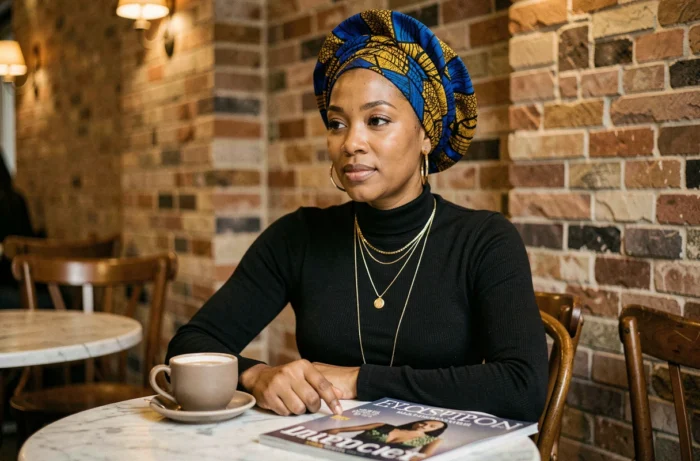
Color and style: pairing a turban with everyday outfits
A turban is a structuring accessory, not just a simple complement. It draws attention to the face. This mechanism requires consideration of the color and proportions of the entire outfit.
A brightly colored turban serves as a centerpiece: the rest of the outfit benefits from remaining understated. A saffron yellow turban worn with black straight pants and a cream blouse is enough to create a bold look without an accumulation of strong pieces.
Conversely, a turban in a neutral tone (beige, gray, off-white) acts as a unifier. It connects the elements of a bohemian outfit with varied patterns or tempers a floral print dress.
Turban and accessories: avoiding overload
Wearing a turban already means wearing a voluminous accessory near the face. Dangle earrings create a visual duplicate that weighs down the head-neck area. Opting for stud earrings or fine hoops maintains balance. A delicate metal choker can complement without competing with the turban.
A scarf tied as a turban offers an alternative to ready-to-wear models. A silk square folded into a triangle and then wrapped around the head creates a more relaxed effect, suitable for a summer look.
Legal framework in France: what the turban changes (and does not change)
Online fashion content rarely addresses the legal dimension of headgear. In France, no law prohibits the turban or scarf covering only the hair in public spaces. The framework remains that of the 2010 law on face concealment, which concerns outfits that mask identity, and the neutrality rules applicable to public agents.
In practice, a chic turban worn as a fashion accessory or as a religious sign remains legal in the street, shops, and most public spaces, as long as it does not conceal the face. This distinction between covered face and covered head is often misunderstood, even though it conditions the dress freedom of many women.
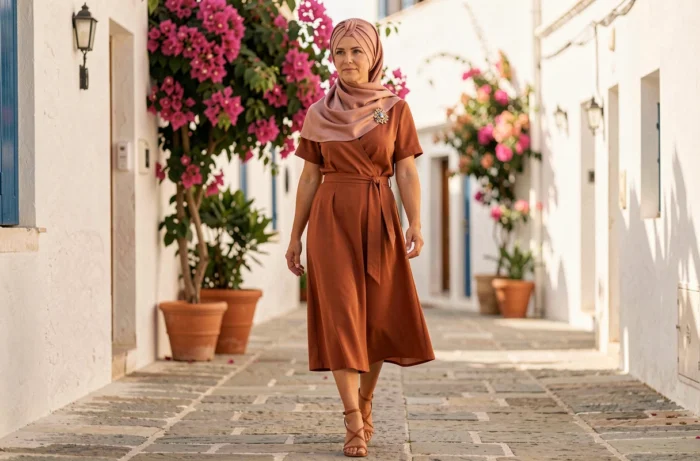
The turban for women today finds itself at a rare convergence of practicality, personal expression, and fashion trend. The choice of material determines comfort, the shape defines the silhouette, and the color guides the overall style of the outfit. An accessory that alters so many parameters deserves a bit more attention than just a simple price filter.