A parent who misses a medical appointment because the booked taxi never arrived, or a loved one who hesitates to leave home due to a lack of suitable transport: these situations happen more often than one might think. When looking for a reliable private driver for an elderly person, the real issue is not the lack of offers, but the difficulty in distinguishing a serious provider from an opportunist.
Professional VTC card and medical check-up: what to check first
Before looking at online reviews or comparing prices, we start with a regulatory point that few families are aware of. Every VTC driver must hold a professional card issued by the prefecture, renewable with a medical fitness certificate for driving dated within the last two years, in accordance with article R221-10 of the Highway Code.
The frequency of this medical check-up varies according to the driver’s age: validity of five years before 60 years, two years between 60 and 76 years, and one year beyond 76 years. Asking to see this card is neither intrusive nor inappropriate. It is the first reliable filter.
The Grandguillaume law of December 29, 2016, also created the possibility of awarding a quality label to VTC operators via article L.3122-4-1 of the Transport Code. When a booking center displays this label, it means that its drivers meet service standards that exceed the minimum requirements. For an elderly person, this is a concrete selection criterion.
When looking to find a private driver for seniors, these administrative checks allow for the quick elimination of profiles that do not meet basic guarantees.
Private driver for seniors: the criteria that matter daily
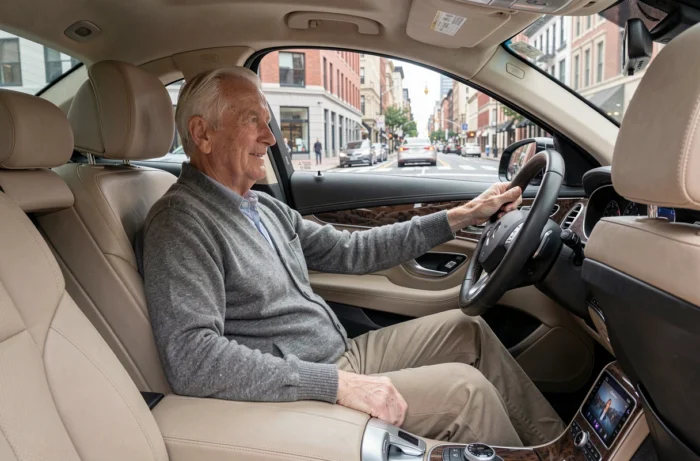
A valid professional card says nothing about a driver’s ability to assist a person with reduced mobility to the door of their doctor. In practice, families who have found a satisfactory provider almost always mention the same points.
- Door-to-door assistance: the driver gets out of the vehicle, helps with getting in and out, waits if the appointment takes longer than expected. This is not a classic taxi service with a running meter.
- The driver’s consistency: for an elderly person, having the same driver from one trip to another reduces anxiety related to travel. Small local companies often offer this continuity, unlike large platforms where the driver changes with each ride.
- Patience and communication: a driver who speaks clearly, who does not blast the radio, who adjusts their speed, makes all the difference for someone who is 80 years old. Feedback varies on this point depending on the providers, but asking the question during the first contact helps gauge the seriousness of the interlocutor.
- The suitable vehicle: a low sedan with high seats makes getting in easier. For wheelchair users, a vehicle with a ramp is necessary, which not all private drivers offer.
Financial aid and schemes to reduce the cost of senior transport
The price of a private driver can quickly weigh on a retiree’s budget. Several schemes exist to lighten the bill, but they are rarely presented clearly.
The APA (personalized autonomy allowance) can include a transport component in the personalized aid plan. Transport is not a category reserved solely for medical care: trips to social activities or grocery shopping can be covered, depending on the assessment by the departmental council.
Some complementary pension funds offer the Sortir Plus scheme, which finances hours of assistance by a driver for everyday outings. The service is accessible to retirees from a certain level of vulnerability, and the hours can be used freely.
The CCAS (communal social action centers) of certain municipalities also organize on-demand transport services at reduced rates for elderly residents. A call to the town hall is enough to find out if this type of service exists locally.
Considering the tax credit for personal services
If the private driver is employed through an accredited personal services organization, the trips qualify for a tax credit. This represents a real reduction in cost, provided that the organization is properly registered and that the invoices specify the nature of the service.

Testing the private driver before committing: a concrete method
You don’t entrust an elderly parent to a stranger based on a well-designed website. The most effective method remains to book a short first trip and accompany the elderly person during this inaugural ride.
During this test trip, you observe revealing details: does the driver arrive early or right on time? Do they spontaneously help with getting settled? Do they adjust their driving? Do they exchange a few words with the person being transported?
After this first trial, asking the parent’s opinion is necessary. An elderly person who says “he was nice” without enthusiasm has probably not been reassured. Someone who remembers the driver’s name has found their provider.
Finally, checking online reviews on platforms like Trustpilot or Google allows for cross-referencing impressions. Comments that specifically mention the transport of elderly people are the most relevant, much more than overall ratings.
The right private driver for a senior is not necessarily the one with the best rate or the newest vehicle. It is the one who understands that they are not transporting a package, but a person who needs security, consistency, and a minimum of human connection to continue going out of their home.